Chinese, Japanese and Arabic PDFs, plus file previews
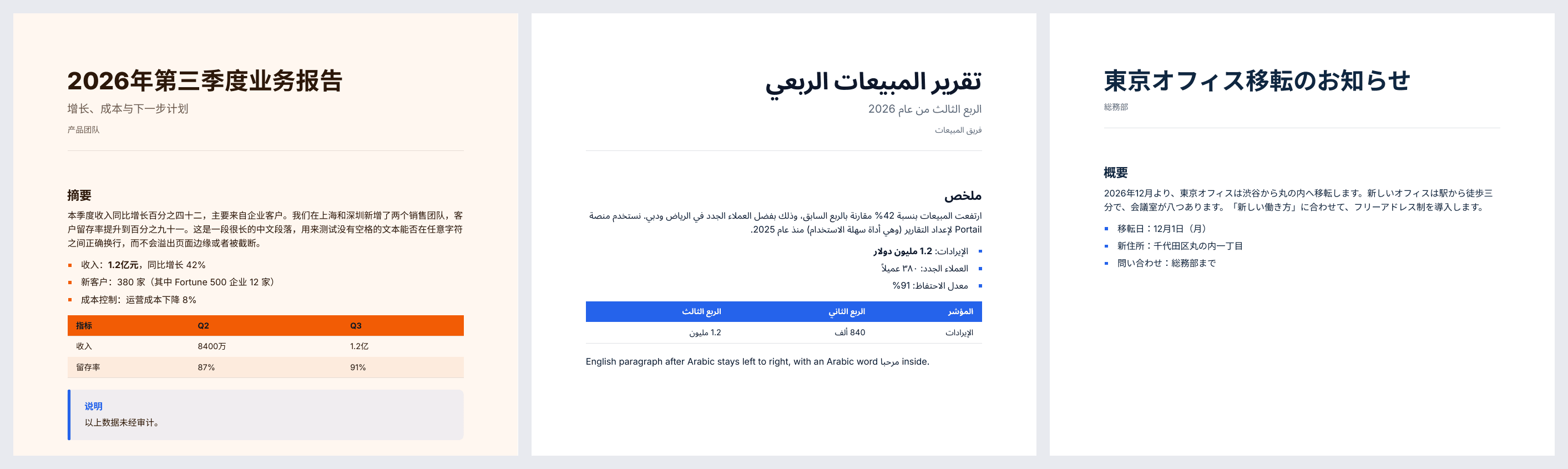
Designed PDFs now handle the languages that used to come out as rows of empty boxes. Chinese, Japanese, Arabic and Hebrew text gets a matching Noto font letter by letter, so a report that mixes English product names with Chinese paragraphs, or Arabic sentences with numbers, reads the way it should. Arabic and Hebrew paragraphs run right to left, with bullets on the right, table columns in reading order and brackets facing the right way. Chinese and Japanese lines wrap between characters instead of spilling off the page, and a Japanese file uses Japanese character shapes rather than Chinese ones. The download card in chat also shows a small picture of the first slide or page of the decks, PDFs and Word files Portail designs for you, so you can see what you got before you open it. And when a deck is so long that it hits the 80-slide limit, the card says how many slides were left out, and the model knows it too, so it can offer to split the content into shorter decks.
681 words
PDFs with Chinese, Japanese, Arabic or Hebrew text no longer show empty boxes: those letters use Noto fonts while English and Russian keep the usual typefaces.
Arabic and Hebrew paragraphs read right to left, with numbers, English words and brackets placed correctly inside them, and lists and tables mirrored to match.
Chinese and Japanese text wraps cleanly between characters, keeps closing punctuation off the start of a line, and stays inside the page.
Japanese files use Japanese forms of shared characters; Chinese files use Simplified Chinese ones.
Slide decks, PDFs and Word files that Portail designs show a preview of their first slide or page right on the download card.
Very long decks stop at 80 slides. When that happens the card tells you how many slides didn't fit, and the model is told as well so it can suggest splitting the deck.
Long links and unbroken words in PDFs now move to the next line and break there instead of running past the edge of the page.
Portail v2.11.3 shipped on 2026-11-11 as a patch release focused on chinese, japanese and arabic pdfs, plus file previews. Designed PDFs now handle the languages that used to come out as rows of empty boxes. Chinese, Japanese, Arabic and Hebrew text gets a matching Noto font letter by letter, so a report that mixes English product names with Chinese paragraphs, or Arabic sentences with numbers, reads the way it should. Arabic and Hebrew paragraphs run right to left, with bullets on the right, table columns in reading order and brackets facing the right way. Chinese and Japanese lines wrap between characters instead of spilling off the page, and a Japanese file uses Japanese character shapes rather than Chinese ones. The download card in chat also shows a small picture of the first slide or page of the decks, PDFs and Word files Portail designs for you, so you can see what you got before you open it. And when a deck is so long that it hits the 80-slide limit, the card says how many slides were left out, and the model knows it too, so it can offer to split the content into shorter decks. The work is recorded here because small releases are still product history. They change how people sign in, read responses, pay for access, share conversations, open files, or trust the system when something goes wrong.
The main changes were direct: pdfs with chinese, japanese, arabic or hebrew text no longer show empty boxes: those letters use noto fonts while english and russian keep the usual typefaces, arabic and hebrew paragraphs read right to left, with numbers, english words and brackets placed correctly inside them, and lists and tables mirrored to match, chinese and japanese text wraps cleanly between characters, keeps closing punctuation off the start of a line, and stays inside the page, japanese files use japanese forms of shared characters; chinese files use simplified chinese ones, slide decks, pdfs and word files that portail designs show a preview of their first slide or page right on the download card, very long decks stop at 80 slides. when that happens the card tells you how many slides didn't fit, and the model is told as well so it can suggest splitting the deck, and long links and unbroken words in pdfs now move to the next line and break there instead of running past the edge of the page. That list is intentionally plain. It names what changed without turning the release into theatre. When a release fixes a build, a redirect, a storage path, or a UI edge case, the value is often that users stop noticing the problem. The archive keeps that invisible work visible enough for future debugging and for anyone checking whether Portail has cared about the details over time.
This version also fits into the wider Portail contract. One account, one chat history, and one model picker only work if the smaller pieces keep their promises. Authentication has to fail clearly. Billing has to count honestly. Uploads have to arrive in a form models can read. Admin tools have to show the operator what happened instead of hiding it behind a blank screen. v2.11.3 moved that contract forward in its own narrow lane.
The screenshots attached to this entry show the public release record as it now appears on portail.cc. For older releases, this archive was rebuilt from the git history, package version changes, release modal text, and commit subjects. That means the page is honest about its source: it documents the shipped change and preserves the record going forward, even when the exact old production screen cannot be recreated from a single saved image.
The practical result is simple. Someone landing on this page can see the version number, date, release tier, headline, highlights, and a real rendered screenshot of the archive page. Search engines can index the post through the canonical URL, sitemap entry, and structured data. Future releases now have a standard to meet before deploy, so the history should get cleaner from here instead of fuzzier.
Screenshots