Skills: teach Portail how you like things done
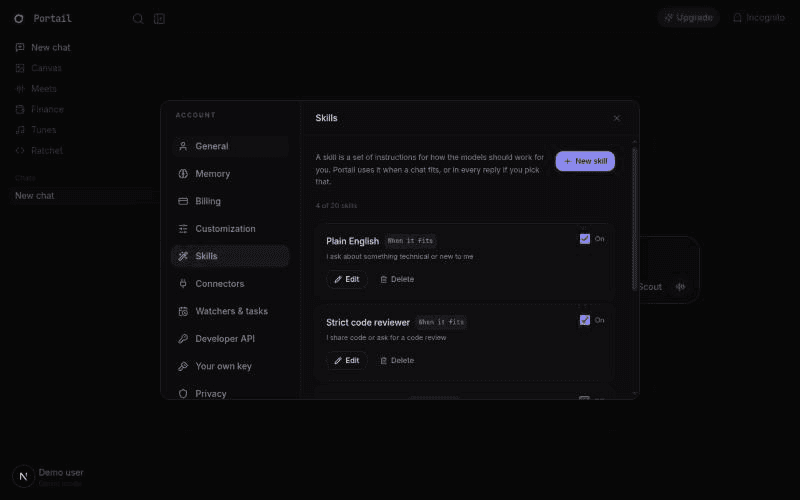
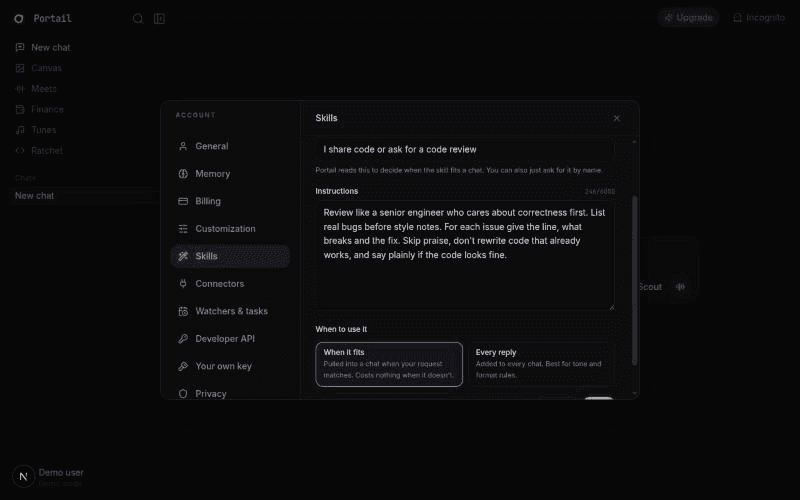
Most people end up typing the same requests into chats over and over. "Explain it like I'm new to this." "Keep it short." "Review this like you actually want to find the bugs." "Write it the way I write emails." Skills let you say that once. Open Settings, pick the new Skills tab, and write a set of instructions for how the models should work for you. Give it a name, a line about when it should be used, and the instructions themselves, and Portail takes it from there. Every skill runs in one of two ways, and you choose which. "When it fits" is the default. Portail reads the "Use it when" line you wrote and pulls the skill into a chat only when your request matches it, so a code review skill shows up when you paste code and stays out of the way when you ask for a dinner recipe. You can also just ask for a skill by name ("use my code review skill on this") and it comes in. A skill that isn't used in a chat adds only its one-line description to that chat, which costs next to nothing. "Every reply" is for rules you want everywhere, like tone and format: answer in short paragraphs, use metric units, never open with a compliment. Those instructions go into every chat you start, so keep them short and to the point. If you've never written instructions for a model before, start from one of the examples on the empty Skills page: Plain English, which turns jargon into everyday words; Strict code reviewer, which lists real bugs before style notes; and Short and direct, which trims the fluff from every reply. Each one opens in the editor so you can change the wording before you save it, and that's usually the best way to learn what works. Every skill has an on and off switch, so you can park one without deleting it, and you can edit or delete it any time. Changes apply from your next message. Skills belong to your account and work in your chats on the web and in the Android app. Incognito chats leave them out, the same way they leave out your memory, so an incognito chat really does start clean. The instructions are loaded on our side from your account; nothing in a chat request can add to them. Skills come from you, not from Portail, so they shape tone, format and approach but never switch off Portail's safety rules. Free accounts can keep three skills and paid plans can keep twenty. If you move to Free with more than three switched on, the extra ones are paused rather than deleted, and the Skills page tells you which. "Every reply" skills also share a size limit, since they ride along with every message; if they add up to more than that, the page shows which one was skipped so you can shorten it or switch it to "When it fits". Skills are in English and Russian, in light and dark, on a phone or a computer. Tell us which skills you end up writing. The good ones may become examples for everyone.
1187 words
New Skills tab in Settings: write instructions once for how the models should work for you, and stop repeating them in every chat.
"When it fits" skills come into a chat only when your request matches their description, or when you ask for one by name. Until then only their one-line description is sent.
"Every reply" skills apply to every chat, for rules like tone, length and format.
Start from an example (Plain English, Strict code reviewer, Short and direct) and edit it before saving.
Switch a skill off without deleting it; edits apply from your next message.
Free accounts keep 3 skills, paid plans 20. Incognito chats don't use skills.
Portail v2.16.0 shipped on 2026-11-18 as a minor release focused on skills: teach portail how you like things done. Most people end up typing the same requests into chats over and over. "Explain it like I'm new to this." "Keep it short." "Review this like you actually want to find the bugs." "Write it the way I write emails." Skills let you say that once. Open Settings, pick the new Skills tab, and write a set of instructions for how the models should work for you. Give it a name, a line about when it should be used, and the instructions themselves, and Portail takes it from there. Every skill runs in one of two ways, and you choose which. "When it fits" is the default. Portail reads the "Use it when" line you wrote and pulls the skill into a chat only when your request matches it, so a code review skill shows up when you paste code and stays out of the way when you ask for a dinner recipe. You can also just ask for a skill by name ("use my code review skill on this") and it comes in. A skill that isn't used in a chat adds only its one-line description to that chat, which costs next to nothing. "Every reply" is for rules you want everywhere, like tone and format: answer in short paragraphs, use metric units, never open with a compliment. Those instructions go into every chat you start, so keep them short and to the point. If you've never written instructions for a model before, start from one of the examples on the empty Skills page: Plain English, which turns jargon into everyday words; Strict code reviewer, which lists real bugs before style notes; and Short and direct, which trims the fluff from every reply. Each one opens in the editor so you can change the wording before you save it, and that's usually the best way to learn what works. Every skill has an on and off switch, so you can park one without deleting it, and you can edit or delete it any time. Changes apply from your next message. Skills belong to your account and work in your chats on the web and in the Android app. Incognito chats leave them out, the same way they leave out your memory, so an incognito chat really does start clean. The instructions are loaded on our side from your account; nothing in a chat request can add to them. Skills come from you, not from Portail, so they shape tone, format and approach but never switch off Portail's safety rules. Free accounts can keep three skills and paid plans can keep twenty. If you move to Free with more than three switched on, the extra ones are paused rather than deleted, and the Skills page tells you which. "Every reply" skills also share a size limit, since they ride along with every message; if they add up to more than that, the page shows which one was skipped so you can shorten it or switch it to "When it fits". Skills are in English and Russian, in light and dark, on a phone or a computer. Tell us which skills you end up writing. The good ones may become examples for everyone. The work is recorded here because small releases are still product history. They change how people sign in, read responses, pay for access, share conversations, open files, or trust the system when something goes wrong.
This was more than a quiet maintenance pass. A minor release changes how a visible part of Portail behaves, how a larger workflow is framed, or how a user understands the product. The important part is not only that the feature exists. The important part is that it joins the rest of the system without making the chat harder to use. Portail is useful because context travels with the user. Every larger release has to protect that feeling.
The main changes were direct: new skills tab in settings: write instructions once for how the models should work for you, and stop repeating them in every chat, "when it fits" skills come into a chat only when your request matches their description, or when you ask for one by name. until then only their one-line description is sent, "every reply" skills apply to every chat, for rules like tone, length and format, start from an example (plain english, strict code reviewer, short and direct) and edit it before saving, switch a skill off without deleting it; edits apply from your next message, and free accounts keep 3 skills, paid plans 20. incognito chats don't use skills. That list is intentionally plain. It names what changed without turning the release into theatre. When a release fixes a build, a redirect, a storage path, or a UI edge case, the value is often that users stop noticing the problem. The archive keeps that invisible work visible enough for future debugging and for anyone checking whether Portail has cared about the details over time.
For this release, the archive points back to the verified commit trail instead of relying on memory. The title, date, and highlights come from the repository history around v2.16.0. That matters because a release log should be boringly checkable. If someone wants to know why a feature appeared, why a page changed, or why a billing rule behaves differently, the public record and the engineering record should not disagree.
This version also fits into the wider Portail contract. One account, one chat history, and one model picker only work if the smaller pieces keep their promises. Authentication has to fail clearly. Billing has to count honestly. Uploads have to arrive in a form models can read. Admin tools have to show the operator what happened instead of hiding it behind a blank screen. v2.16.0 moved that contract forward in its own narrow lane.
The product lesson is also worth naming. Portail grew quickly through chat, admin, billing, Canvas, Omniverse, Agents, and the coding hand-off bridge. Features landed close together, and some releases bundled polish with deeper infrastructure. This post separates the user-facing promise from the implementation noise. It says what the release changed, why that mattered, and where it sits in the product timeline.
The screenshots attached to this entry show the public release record as it now appears on portail.cc. For older releases, this archive was rebuilt from the git history, package version changes, release modal text, and commit subjects. That means the page is honest about its source: it documents the shipped change and preserves the record going forward, even when the exact old production screen cannot be recreated from a single saved image.
The practical result is simple. Someone landing on this page can see the version number, date, release tier, headline, highlights, and a real rendered screenshot of the archive page. Search engines can index the post through the canonical URL, sitemap entry, and structured data. Future releases now have a standard to meet before deploy, so the history should get cleaner from here instead of fuzzier.
Screenshots