Chat replies tuned to how you work
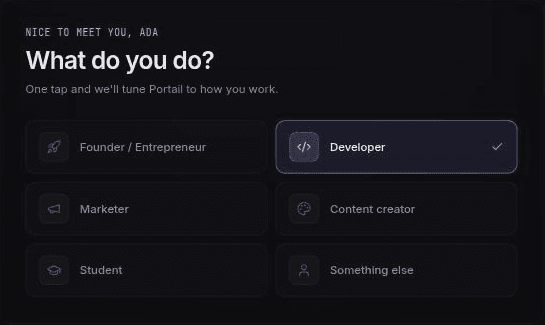
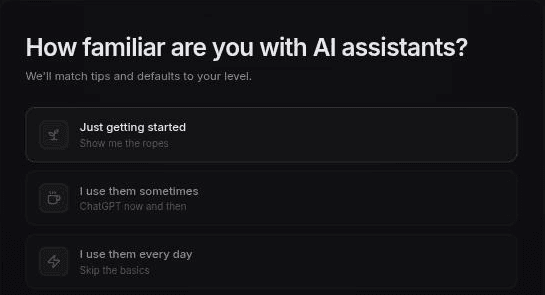
When you signed up, Portail asked what you do, what you're mainly there for, and how familiar you already are with AI assistants. Those answers used to go nowhere, sitting in the database and only ever showing up in the admin panel. Every chat reply now reads them first. A developer debugging something gets a more direct answer with less hand holding. Someone new to AI assistants gets plainer language instead of jargon. None of this shows up as a new setting or a new screen. It works quietly, on every account that already finished onboarding, starting with this release.
701 words
Chat replies now read your onboarding answers (role, primary goal, experience with AI tools) and adjust tone, depth, and examples accordingly.
Applies automatically to every account that already completed onboarding. Nothing new to turn on.
Fixed the admin dashboard's 24-hour view, which used to interpolate invented hourly numbers between two real daily totals instead of showing real data.
Portail v2.4.0 shipped on 2026-09-30 as a minor release focused on chat replies tuned to how you work. When you signed up, Portail asked what you do, what you're mainly there for, and how familiar you already are with AI assistants. Those answers used to go nowhere, sitting in the database and only ever showing up in the admin panel. Every chat reply now reads them first. A developer debugging something gets a more direct answer with less hand holding. Someone new to AI assistants gets plainer language instead of jargon. None of this shows up as a new setting or a new screen. It works quietly, on every account that already finished onboarding, starting with this release. The work is recorded here because small releases are still product history. They change how people sign in, read responses, pay for access, share conversations, open files, or trust the system when something goes wrong.
This was more than a quiet maintenance pass. A minor release changes how a visible part of Portail behaves, how a larger workflow is framed, or how a user understands the product. The important part is not only that the feature exists. The important part is that it joins the rest of the system without making the chat harder to use. Portail is useful because context travels with the user. Every larger release has to protect that feeling.
The main changes were direct: chat replies now read your onboarding answers (role, primary goal, experience with ai tools) and adjust tone, depth, and examples accordingly, applies automatically to every account that already completed onboarding. nothing new to turn on, and fixed the admin dashboard's 24-hour view, which used to interpolate invented hourly numbers between two real daily totals instead of showing real data. That list is intentionally plain. It names what changed without turning the release into theatre. When a release fixes a build, a redirect, a storage path, or a UI edge case, the value is often that users stop noticing the problem. The archive keeps that invisible work visible enough for future debugging and for anyone checking whether Portail has cared about the details over time.
For this release, the archive points back to the verified commit trail instead of relying on memory. The title, date, and highlights come from the repository history around v2.4.0. That matters because a release log should be boringly checkable. If someone wants to know why a feature appeared, why a page changed, or why a billing rule behaves differently, the public record and the engineering record should not disagree.
This version also fits into the wider Portail contract. One account, one chat history, and one model picker only work if the smaller pieces keep their promises. Authentication has to fail clearly. Billing has to count honestly. Uploads have to arrive in a form models can read. Admin tools have to show the operator what happened instead of hiding it behind a blank screen. v2.4.0 moved that contract forward in its own narrow lane.
The product lesson is also worth naming. Portail grew quickly through chat, admin, billing, Canvas, Omniverse, Agents, and the Portail Code bridge. Features landed close together, and some releases bundled polish with deeper infrastructure. This post separates the user-facing promise from the implementation noise. It says what the release changed, why that mattered, and where it sits in the product timeline.
The screenshots attached to this entry show the public release record as it now appears on portail.cc. For older releases, this archive was rebuilt from the git history, package version changes, release modal text, and commit subjects. That means the page is honest about its source: it documents the shipped change and preserves the record going forward, even when the exact old production screen cannot be recreated from a single saved image.
The practical result is simple. Someone landing on this page can see the version number, date, release tier, headline, highlights, and a real rendered screenshot of the archive page. Search engines can index the post through the canonical URL, sitemap entry, and structured data. Future releases now have a standard to meet before deploy, so the history should get cleaner from here instead of fuzzier.
Screenshots