Watchers: Portail keeps an eye on things and only speaks up when they change
Tell Portail what you're waiting for, in plain words, and it watches for you: a price dropping under your number, an email from your university about exam dates, a company finally announcing its event, real news on a topic you follow. Portail checks the web and your connected apps on its own and stays completely quiet until it finds something new that matches. Then it sends you one short message on Telegram or by email with what changed, the numbers that matter and the link. That silence is the point. A watcher that pings you every hour to say nothing happened is a newsletter, and newsletters get muted. Free checks once a day, Pro every 3 hours, Plus and Ultra every hour. Find them in Settings > Watchers & tasks.
1079 words
Describe what you're waiting for in plain words. Portail checks the web and your connected apps and says nothing until something new matches.
When it finds something you get one short alert on Telegram or by email: what changed, the numbers that matter, and the link to see it yourself.
Portail remembers what it already told you and skips an alert that repeats one you've had, so the same price drop or announcement doesn't keep coming back.
Every check ends in a strict yes or no. A check that can't give a clear answer counts as a failed check and never turns into an alert, so a confused model can't spam you.
The first check runs the moment you save. If the laptop is already under $900, you hear about it today, not tomorrow.
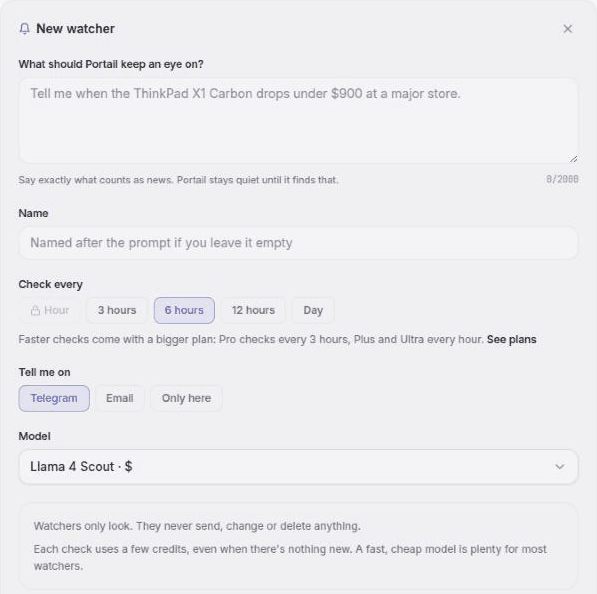
How often a watcher looks depends on your plan: Free once a day, Pro every 3 hours, Plus and Ultra every hour. Faster options are visible in the form with a lock, so you know what an upgrade gets you.
If you move to a plan that checks less often, your watchers keep their settings and slow down to what the plan allows instead of stopping.
Watchers only read. They can spot the email you're waiting for in Gmail or a change in your Calendar, but they can never send, change or delete anything. That stays with scheduled tasks and their own consent step.
Every check is an ordinary model run and uses a few credits from your normal allowance, even when it finds nothing. A fast, cheap model is the right pick for most watchers, and the form says so.
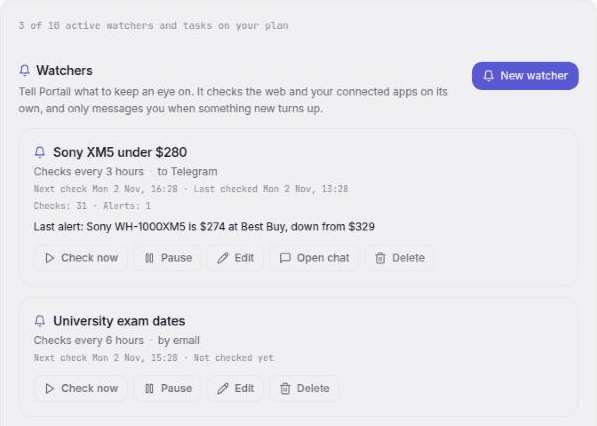
Each watcher shows how many times it has checked, how many alerts it has sent and the last thing it found.
Check now runs a check on the spot and tells you plainly when there's nothing new.
Alerts land in the watcher's own chat, so you can reply and dig in with any model. On Telegram, replying to an alert continues that chat.
The settings tab is now called Watchers & tasks, with a few ready-made watchers to start from. Scheduled tasks live right below, unchanged.
The Telegram bot's /tasks list marks watchers with a bell, so you can pause or resume them from your phone.
If you change what a watcher looks for, it starts over and checks the new condition right away.
Portail v2.9.0 shipped on 2026-11-06 as a minor release focused on watchers: portail keeps an eye on things and only speaks up when they change. Tell Portail what you're waiting for, in plain words, and it watches for you: a price dropping under your number, an email from your university about exam dates, a company finally announcing its event, real news on a topic you follow. Portail checks the web and your connected apps on its own and stays completely quiet until it finds something new that matches. Then it sends you one short message on Telegram or by email with what changed, the numbers that matter and the link. That silence is the point. A watcher that pings you every hour to say nothing happened is a newsletter, and newsletters get muted. Free checks once a day, Pro every 3 hours, Plus and Ultra every hour. Find them in Settings > Watchers & tasks. The work is recorded here because small releases are still product history. They change how people sign in, read responses, pay for access, share conversations, open files, or trust the system when something goes wrong.
This was more than a quiet maintenance pass. A minor release changes how a visible part of Portail behaves, how a larger workflow is framed, or how a user understands the product. The important part is not only that the feature exists. The important part is that it joins the rest of the system without making the chat harder to use. Portail is useful because context travels with the user. Every larger release has to protect that feeling.
The main changes were direct: describe what you're waiting for in plain words. portail checks the web and your connected apps and says nothing until something new matches, when it finds something you get one short alert on telegram or by email: what changed, the numbers that matter, and the link to see it yourself, portail remembers what it already told you and skips an alert that repeats one you've had, so the same price drop or announcement doesn't keep coming back, every check ends in a strict yes or no. a check that can't give a clear answer counts as a failed check and never turns into an alert, so a confused model can't spam you, the first check runs the moment you save. if the laptop is already under $900, you hear about it today, not tomorrow, how often a watcher looks depends on your plan: free once a day, pro every 3 hours, plus and ultra every hour. faster options are visible in the form with a lock, so you know what an upgrade gets you, if you move to a plan that checks less often, your watchers keep their settings and slow down to what the plan allows instead of stopping, watchers only read. they can spot the email you're waiting for in gmail or a change in your calendar, but they can never send, change or delete anything. that stays with scheduled tasks and their own consent step, every check is an ordinary model run and uses a few credits from your normal allowance, even when it finds nothing. a fast, cheap model is the right pick for most watchers, and the form says so, each watcher shows how many times it has checked, how many alerts it has sent and the last thing it found, check now runs a check on the spot and tells you plainly when there's nothing new, alerts land in the watcher's own chat, so you can reply and dig in with any model. on telegram, replying to an alert continues that chat, the settings tab is now called watchers & tasks, with a few ready-made watchers to start from. scheduled tasks live right below, unchanged, the telegram bot's /tasks list marks watchers with a bell, so you can pause or resume them from your phone, and if you change what a watcher looks for, it starts over and checks the new condition right away. That list is intentionally plain. It names what changed without turning the release into theatre. When a release fixes a build, a redirect, a storage path, or a UI edge case, the value is often that users stop noticing the problem. The archive keeps that invisible work visible enough for future debugging and for anyone checking whether Portail has cared about the details over time.
For this release, the archive points back to the verified commit trail instead of relying on memory. The title, date, and highlights come from the repository history around v2.9.0. That matters because a release log should be boringly checkable. If someone wants to know why a feature appeared, why a page changed, or why a billing rule behaves differently, the public record and the engineering record should not disagree.
This version also fits into the wider Portail contract. One account, one chat history, and one model picker only work if the smaller pieces keep their promises. Authentication has to fail clearly. Billing has to count honestly. Uploads have to arrive in a form models can read. Admin tools have to show the operator what happened instead of hiding it behind a blank screen. v2.9.0 moved that contract forward in its own narrow lane.
The product lesson is also worth naming. Portail grew quickly through chat, admin, billing, Canvas, Omniverse, Agents, and the coding hand-off bridge. Features landed close together, and some releases bundled polish with deeper infrastructure. This post separates the user-facing promise from the implementation noise. It says what the release changed, why that mattered, and where it sits in the product timeline.
The screenshots attached to this entry show the public release record as it now appears on portail.cc. For older releases, this archive was rebuilt from the git history, package version changes, release modal text, and commit subjects. That means the page is honest about its source: it documents the shipped change and preserves the record going forward, even when the exact old production screen cannot be recreated from a single saved image.
The practical result is simple. Someone landing on this page can see the version number, date, release tier, headline, highlights, and a real rendered screenshot of the archive page. Search engines can index the post through the canonical URL, sitemap entry, and structured data. Future releases now have a standard to meet before deploy, so the history should get cleaner from here instead of fuzzier.
Screenshots